2026 Best Hand Crank Coffee Grinder for Camping?

A Hand Crank Coffee Grinder For Camping can turn a quiet campsite morning into a better coffee ritual. It also demands a little effort. Cold fingers, uneven ground, and limited pack space quickly expose a grinder’s weaknesses. The right choice should feel steady in your hand, not merely look rugged in a product photo.

Coffee educator James Hoffmann often stresses that grinder quality matters to the final cup. Put simply, that is the practical lesson behind this guide: consistent grounds make brewing easier to control. This is a paraphrase, not a direct quotation. A compact burr grinder with clear adjustment steps can help you move from a finer pour-over grind to a coarser brew. A firm handle and a secure catch cup matter, too. Nobody wants grounds scattered across a picnic table.

The 2026 guide compares hand grinders for portability, grind consistency, adjustment range, capacity, and ease of cleaning. It also considers real campsite details: a small pack, a damp morning, and the time required to grind enough beans for two cups. Some models may look tough but feel tiring after a few minutes. That trade-off deserves attention. Hand grinding is not effortless, and no single grinder suits every camper. Use these comparisons to choose a dependable option for your brewing style, budget, and usual trip length.
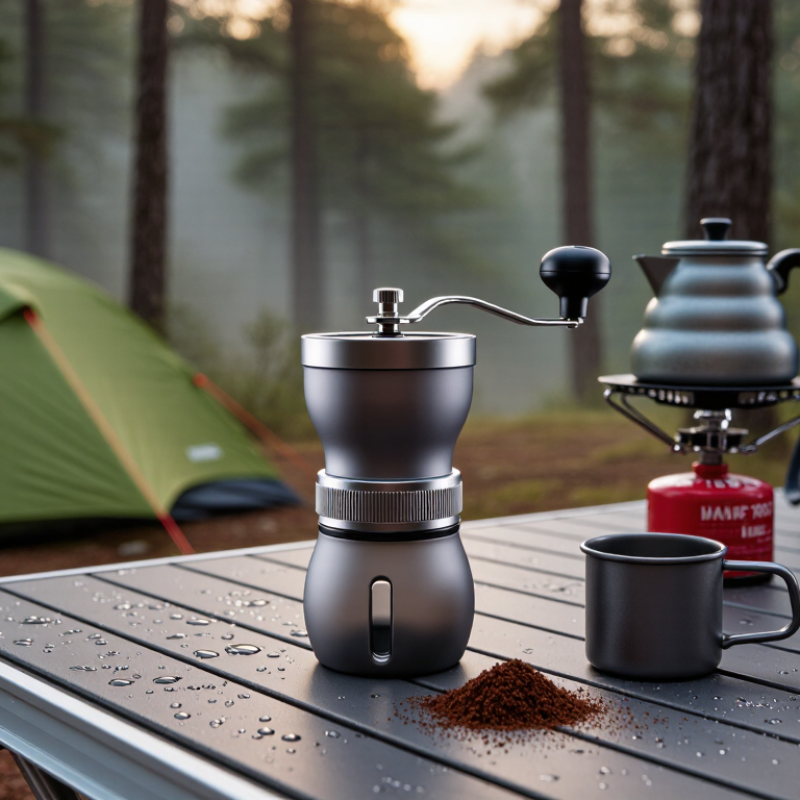
2026 Best Hand Crank Coffee Grinder for Camping?

What Is a Hand Crank Coffee Grinder for Camping?

A hand crank coffee grinder for camping is a compact, manually operated tool that crushes whole beans between burrs. Turning the handle needs no battery or outlet, making it useful at a tent, trailhead, or picnic table. Many models let you adjust the burr gap for different brewing methods, from coarse grounds for a press to finer grounds for pour-over. The adjustment is practical, though tiny parts can be fiddly with cold fingers.

Not magic.

A burr grinder also gives more control over particle size than simply chopping beans with blades. That can help water extract coffee more evenly, but grind size alone cannot fix stale beans or poor brewing technique. The National Coffee Association’s 2024 National Coffee Data Trends report found that 67% of U.S. adults had coffee in the past day. That figure describes everyday coffee habits, not camping-grinder use; it does show why fresh preparation matters to many drinkers.

For camp use, check the grinder’s weight, handle stability, adjustment range, and how easily grounds can be emptied. A little coffee dust will escape. Pack it in a small dry pouch, and test the setting at home before relying on it outdoors.

How to Choose a Camping Coffee Grinder in 2026

Choosing a camping coffee grinder starts with your actual routine, not a long list of features. If you brew for one, a compact grinder with a modest bean capacity may be enough. For a group, frequent refills can become annoying beside a cold campsite stove. Check the packed length and weight, then imagine carrying it with your mug, fuel, and food.

The grinding mechanism matters too. A stable burr set and adjustable settings help you move between finer coffee for a small brewer and coarser grounds for a press. Look for a crank that turns smoothly without wobbling, and a handle that stores securely. Try the grip if possible; a tiny knob can feel awkward with cold fingers. Small detail, big difference.

Damp mornings happen. A grinder that comes apart simply is easier to brush clean, but avoid washing parts unless the maker says they are safe to wet. Metal construction may feel sturdy, while lighter materials save pack space; neither choice is perfect. I’d prioritize dependable adjustment and easy cleaning over shaving off a few grams. One caveat: “portable” does not always mean comfortable to use. Check that the base sits firmly on a rock or camp table before grinding.

How Burr Design and Grind Settings Affect Coffee Quality

A hand-crank grinder’s burrs shape more than convenience at a campsite. They determine how evenly beans break apart, which affects extraction and flavor. Conical burrs often suit portable grinders because their compact design works well with a steady hand crank. Flat burrs can also produce consistent grounds, but the grinder’s build and alignment matter as much as burr shape. Design alone is not a guarantee.

Look at the adjustment range, too. Coarse settings suit immersion brewing in a camp mug or press, while finer settings help with pour-over and some compact brewers. Clear, repeatable clicks make it easier to return to a setting after cleaning. Tiny adjustments can be frustrating with cold fingers. And loose parts are no fun.

A practical test is to grind a small batch and inspect it in daylight. If the grounds contain many powdery fines alongside obvious chunks, extraction may turn uneven: bitter in places, thin in others. Still, outdoor brewing has variables. Wind, water temperature, and a rushed pour can muddy comparisons. I would not chase perfect uniformity at the expense of pack weight or a stable crank. Check whether the handle folds securely, and whether the grind collar stays put during use. A little trial and error is normal.

2026 Best Hand Crank Coffee Grinder for Camping? - How Burr Design and Grind Settings Affect Coffee Quality

A practical comparison of common hand-grinder features. Capacity, weight, burr dimensions, and adjustment counts vary by model; ranges below are typical examples, not specifications for a particular grinder.

Feature Typical Details Effect on Coffee Quality Camping Consideration What to Look For
Burr design Most compact hand grinders use conical burrs; burr geometry and alignment differ between designs. Consistent particle size helps water extract coffee more evenly. Excessive fines or oversized particles can contribute to uneven extraction. Conical burrs are common in portable grinders and work without electricity. Look for securely supported burrs and a shaft that stays stable while grinding.
Burr material Common options include stainless steel and ceramic. Material alone does not determine cup quality; burr geometry, sharpness, alignment, and consistency also matter. Stainless steel burrs are generally less brittle than ceramic, while either type should be protected from grit and impacts. Choose a design with replaceable or accessible burr components if long-term maintenance matters.
Grind adjustment Adjustments may be stepped, with distinct clicks, or stepless, with continuous adjustment. Click counts are not directly comparable across grinders. Repeatable adjustments make it easier to dial in a brew and return to a preferred setting. Clear, secure settings are useful when changing brew methods outdoors or packing the grinder between uses. Check that the setting does not shift easily during grinding and that the adjustment can be repeated.
Brewing range Many hand grinders are designed for filter coffee, French press, or espresso; not every model handles all ranges equally well. Different brewing methods generally require different particle sizes. A suitable, consistent range matters more than a large number of advertised clicks. For a single camping brew method, a grinder optimized for that method may be simpler to use. Confirm that the grinder can produce the grind size required by your brewer, including a sufficiently fine setting if making espresso.
Capacity Compact models commonly hold roughly 20–40 g of beans per load; actual capacity depends on the chamber and bean size. Capacity does not directly improve extraction, but grinding the needed dose fresh supports consistent preparation. Compare capacity with the number of servings you make; larger batches may require multiple loads. Check usable bean capacity rather than relying only on the grinder's overall dimensions.
Weight and portability Portable hand grinders vary widely; many compact models weigh a few hundred grams, with heavier designs often using more metal or larger components. Weight does not determine flavor, though a stable grinder can be easier to operate consistently. For backpacking, weigh the grinder with its handle and any protective case; car camping allows more flexibility. Balance packed weight, durability, and ease of gripping rather than choosing by weight alone.
Handle and grinding effort Handle length, grip shape, burr size, bean hardness, and grind setting all affect the effort required. Comfort does not change the grind directly, but a smooth, stable operation can help produce a more repeatable result. A folding or removable handle packs neatly, while a secure grip is helpful when grinding outdoors. Look for a handle that attaches firmly and turns without noticeable wobble.
Cleaning and durability Ground coffee oils and particles can accumulate; cleaning access varies by design. Regular dry cleaning helps prevent old residue from affecting the aroma of later batches. Simple disassembly and a durable carry case can help protect the grinder from dust and knocks. Check the manufacturer's cleaning guidance and avoid washing burrs with water unless the instructions allow it.
Overall camping fit There is no single best configuration for every trip or brewing method. For flavor, prioritize a consistent grind and an adjustment range suited to your brewer. For hiking, prioritize compactness and low packed weight; for car camping, capacity and ease of use may matter more. Best general priority: stable burr alignment, repeatable adjustment, suitable brew range, and a size you are willing to carry.

How Portability, Capacity, and Durability Compare

A hand crank grinder can make better coffee at camp, but its size matters before its grind quality does. A compact model slips into a mug or side pocket and adds little weight to a daypack. The trade-off is usually a smaller bean chamber, which may mean grinding twice for two people. Check the grinder’s assembled height and handle length, not just its listed weight. A long handle can catch on packed gear.

Capacity affects more than convenience. A hopper holding around 20 to 30 grams may suit one strong cup, while a larger chamber saves time for a group. Yet extra capacity often brings a wider body and more weight. For a cold morning, grinding several small batches with stiff fingers can feel tiresome. That detail is easy to miss.

Durability depends on the parts that take repeated force: the crank joint, axle, and burr alignment. Metal components generally tolerate bumps better than thin plastic, but they can add weight. Look for a handle that folds or detaches securely, and a lid that stays closed inside a pack. Dust and fine grounds can work into moving parts, so simple cleaning access matters. A rugged shell is reassuring, though it cannot prevent every loose screw or worn bearing. Check the mechanism occasionally; camp use is rougher than a kitchen counter.

2026 Best Hand Crank Coffee Grinder for Camping?

How portability, capacity, and durability compare

These approximate, non-brand-specific figures illustrate common trade-offs: lighter grinders are easier to pack but often hold fewer beans, while larger models add weight for bigger batches. For durability, look for a sturdy metal body, a well-supported crank, and replaceable burrs; actual specifications vary by model.

How to Use and Maintain a Hand Crank Grinder Outdoors

A hand crank grinder works best when it sits on a steady, level surface. At camp, a flat rock or picnic table can help, but check that the grinder will not slide. Add a small amount of whole-bean coffee, then turn the handle with slow, even pressure. Fast cranking can make the grinder wobble, especially on uneven ground. Cold fingers make this harder. Take your time.

Set the grind size before brewing, following the grinder’s instructions. A coarser setting generally suits immersion brewing, while pour-over usually needs a finer grind. Make a small test batch before grinding all your beans; outdoor conditions and personal taste can change what feels right. I sometimes find the first cup a little uneven, and that is a useful reason to adjust gradually rather than force the handle.

After use, empty the grounds and brush loose particles from the burr area. Keep water away unless the care instructions specifically allow washing. A damp cloth can clean the exterior, but dry it fully before packing. Keep the grinder in a dry pouch, separate from damp cookware. Check the handle and adjustment parts now and then. Small grit can hide in the threads.